
What is LLM (Large Language Model) ?
LLM (Large Language Model) is an artificial intelligence (AI) model based on multi-layer recurrent neural networks that is trained using large amounts of data to produce human-like text and understands, creates, and manipulates human language.
How does LLM work ?
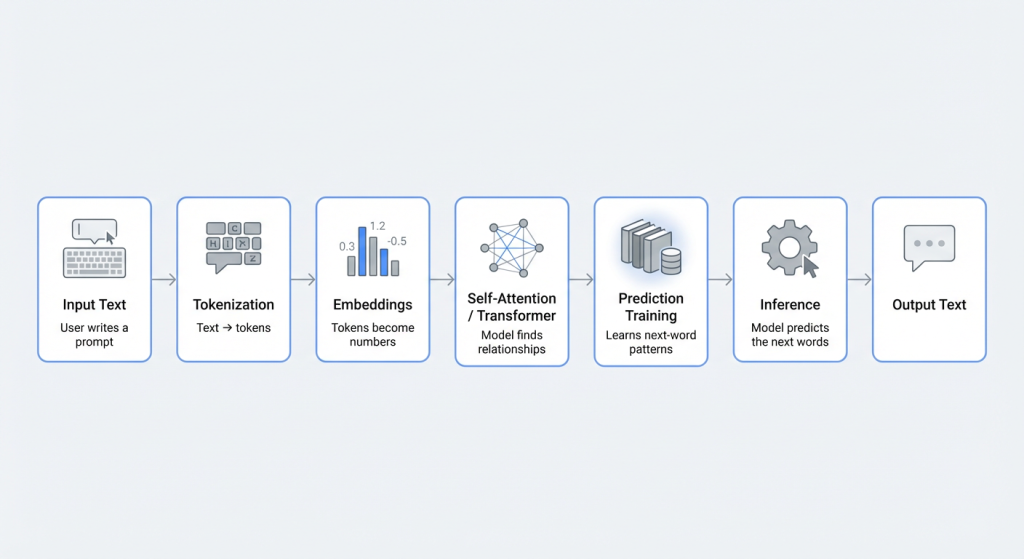
LLM (Large Language Model) is based on a special neural network architecture called Transformer, which uses a method called “self-attention” to understand the relationships and context between words and sentences. LLM can learn from large amounts of text data to predict the probability of the next part of a word or sentence and is able to accurately produce answers or text in human-like language.
Just like a child, at first he doesn’t know much, not even words, language, customs, or rules. He tries to say or do whatever he is taught or informed about from a young age.Over time, the scope of his knowledge or understanding expands, and so does his ability to make inferences and express them based on his surroundings.
Similarly, an LLM (Large Language Model) can only do as much as it is taught.Thus, a large language model can increase its learning range/self-attention and predict the next word.
Now the question is, how does a computer answer questions if it doesn’t understand human language? And how does it construct a sentence by putting words together one after another?
LLM (Large Language Model) assigns a different number to each word. The computer calculates this number and guesses the next number, that is, it guesses the next word and creates a sentence. In this way, a large language model makes predictions, or calculations, based on your question and gives you the answer.
Let’s understand how the Large Language Model calculates through an example,
We know mango, jam, jackfruit, litchi, pineapple, watermelon, apple, orange as fruits. Again, we know cats, cows, goats, ducks, chickens, sheep, elephants, tigers, monkeys, pigeons, and roosters as animals.
| Human | Mango | Jackfruit | Lychee | Pineapple | Watermelon | Apple | Orange |
| LLM | 1 | 2 | 3 | 4 | 5 | 6 | 7 |
But a large language model doesn’t understand these languages, it understands numbers and converts each name into a number and calculates accordingly.
Cow ………….. grass.
Cows eat grass. We know this because we have seen it, which allows us to guess the next word. But a large language model can only guess the next word if it is told or knows something like that in advance.
In this way, after a large language model has been calculated many times, it can guess the next word or number and thereby attempt to answer a question based on it.
If we understand with another example.
As students, we did fill-in-the-blank or completing stories many times and even took tests.In a completing story, we can only write completely when we know the story completely or fill in a gap when we have an idea or grammar about that information.
Caught,
The student goes to …………….
We were able to guess the next word because we know that a student will go to that school. But a large language model can only predict this if it has a large data set, or is trained in that way, or trains itself through a neural network. If he doesn’t have such a wealth of information, he can give space instead of school.
Or instead of “The tiger ate the deer,” they might answer “The deer ate the tiger!”


The more a large language model is trained, the more data it is given, and the more neural networks it can train itself through, the more powerful that large language model becomes and the better results it can produce.
This is how each large language model works and is created. For example: GPT-5, GPT-2.5, GPT-5.1, GPT-4.1, etc.
Leave a Reply